The New Objectivity and Constructivism in Czech Inter-War Photography
Vladimír Birgus
Purist pictorialism, rejecting oil printing, rubber printing and other specialized printing techniques, was introduced to Prague in 1921 by Drahomír Josef Ružička an American doctor and amateur photographer of Czech origin and propagator of the ideas of Stieglitz and White. In the first half of the twenties, it influenced many Czech photographers including Josef Sudek, Jaromír Funke and Adolf Schneeberger, but after a few years it was already clear that it was becoming an anachronism and its programme was to a large extent exhausted. Many ambitious professional photographers and above all amateurs constantly watered down in motif and style, the works of its pioneers, without much inventiveness, and created nice unchallenging pictures with softly depicted, simple objects or sentimental genre scenes.
Some of its original propagators appeared in the opposition against this orientation. Instead of the softly drawing lens, softening lens or fabrics placed during enlargement on sensitive paper, they gradually began to emphasize cutting sharpness of tonally rich enlargements, restraint of the subjective point of view and a transition from romantic and lyrical motifs to strictly rational depiction of many apparently entirely unaesthetic motifs from the spheres of technology, industry or architecture. This “new photography“ so often emphasized un-traditional compositions with diagonals, significant underviews and overviews and large details, so that it combined typical features of the New Objectivity and Constructivism. Its representatives wanted to show the world around them in a new way, un-clichéd and surprising. At the same time, they wanted to empha-size specific features of the photographic medium, and to depict and interpret motifs, which had previously stood aside from the attention of photographers. In contrast to the representatives of Impressionist and Secession pictorialism, they emphasized the preciseness and objectivity of the photographic image, but also its out of the ordinariness when depicting the ordinary, and the possibilities for artistic stylization by means of the transfer of coloured three-dimensional reality into the black and white two-dimensional image, changes of scale and perspective or the use of unusual angles of view. They were supported in this by the interest of Avant-garde artists in new arts, especially photography and film. In his article The Photograph and Cine-Film, published in the magazine Život 2 (1922), only two years after the foundation of the artistic society Devětsil, the most important theorist of the Czech Avant-garde Karel Teige placed demands for purposefulness and truthfulness on modern photography and opposed Impressionist and Secessionist pictorialism: Yes, the morality of photography lies in reality and truthfulness, after all veracity always applies after virtue and agrees with the purpose for which photography was invented. (...) The merit of photography for curing painting of Impressionism is immense, but painting repaid its debt to photography badly: it infected photography with Impressionism, making it into artistic photography, something false, like artistic industry.1
Czech new photography, like typography, architecture or design, was significantly influenced by the famous German Bauhaus school, at which a number of Czechs and Slovaks studied. They included Jindrich Koch, who later became the successor of Hans Finsler as head of the photographic department in the School of Applied Art at Giebichenstein Castle near Halle, and before his tragic death in 1934, briefly active as photographer of the National Museum in Prague; Zdeněk Rossmann architect, graphic designer, scenographer, photographer and teacher at the School of Arts and Crafts in Bratislava (1932-1938) and Brno (1939-1943); his wife Marie Rossmannová also a photographer; and the Slovak Irena Blühová, later organizer of the movement of social photography in Bratislava. In 1929, Karel Teige was invited by Hannes Mayer director of the Bauhaus at the time, with whom he shared many radical Functionalist views, to a cycle of lectures about the sociology of architecture, typography and aesthetics. Jaromír Funke also considered studying at the Bauhaus, but in the end he gave priority to teaching activity at the School of Arts and Crafts in Bratislava. In 1930, a German graduate of the Bauhaus Werner Feist settled in Prague for a time.
The inspirational example of the conception of teaching at the Bauhaus was strongest in the schools of arts and crafts in Bratislava2 and Brno.3 Rich contacts with the Czech Avant-garde were maintained especially by László Moholy- Nagy, who already lectured on painting, photography and film in Brno on the invitation of Devětsil. After leaving the Bauhaus, he exhibited independently several times in Czechoslovakia (for example in June 1935 in the Künstlerhaus in Brno, later at the School of Arts and Crafts and in March 1936 together with the Fotolinia group, members of the German Amateur Photography Club from České Budějovice and members of the Brno Photographic Group of Five, he participated in the Exhibition of International Photography in the Institute for Promoting the Crafts in České Budějovice). František Kalivoda, head of the Brno branch of the Film-photo group of the Left Front, finally devoted to his work the whole introductory (and last) double number of the exclusive new magazine Telehor, which is now quoted in all monographs about Moholy-Nagy and is highly valued by collectors throughout the world. The photographs and photo-montages of Moholy-Nagy and other teachers and students of the Bauhaus, together with the works of Albert Renger-Patzsche, Aenne Biermann and other German photographers, were often reproduced in many other Czech Avant-garde magazines.
Czech Avant-garde photography, with its untraditional over-views, underviews or diagonal compositions, stood close to the representatives of Soviet Avant-garde photography. Soviet Avant-garde art reached Czechoslovakia more sporadically than French or German, but it was followed with great interest. Soviet photographers were represented at the Prague exhibitions of social photography in 1933 and 1934, and at the International Exhibition of Photography in the Mánes at Prague in 1936, an extensive collection of Soviet work including works of Alexander Rodchenko, Boris Ignatovich, Max Alpert, Arkady Shaykhet, Galina Sanková, Marek Markov, Boris Kudoyarov, Georgy Petrusov, Ivan Shagin and Georgy Zelma, thanks to the leftist theoretician of photography and film Lubomír Linhart and the Soyuzfoto agency. Apart from works in the style of Constructivism, built up shots in the spirit of socialist realism and official photographs of the visit of President Edvard Beneš to Moscow and Leningrad and his meetings with Stalin and Voroshilov had a lot of space.
Since Czech artists could be inspired by works of the German, Soviet or French Avant-garde, in many cases it was not only a matter of plagiarizing and watering down foreign examples, but also of creating very original and progressive works. Jaroslav Rössler can be a good example in this area. He produced abstract compositions and Constructivist photos, which are among the oldest even in the world context. He was the only professional photographer among the members of the Czech Avant-garde group Devětsil, into which he was accepted in 1923 on the initiative of Karel Teige, who was impressed with his work up to then. At the time, Rössler was still an assistant to the most important representative of Czech pictorialist photography František Drtikol. The Symbolism and Secession flavour of Drtikol’s works were foreign to this modernist oriented artist, but he did not resist his teacher’s influence. For example, this is shown by the use of the bromoil printing technique, which he applied in some abstract compositions and photomontages, in the imaginative cubo-futurist portrait of the dancer Ore Tarraca, and finally also in some shots in Paris. Even before the end of his training period, that is about 1919, Rössler created the so-called Opus I in Drtikol’s studio, a geometric composition with an angular bottle, which already has some elements of Constructivism.
Alongside the works of Alvin Langdon Coburn or Christian Schad, the series of photographs by Rössler of geometric surfaces, lights, shadows and reflections from the first half of the twenties have a place among the first examples of the influence of abstract art in photography. In a further part of his creative work, he caught elementary minimalist motifs, for example the light in the printing room of Drtikol’s studio. In many compositions, he combined plays of light and shade or cut out geometric shapes in the background with various traditional objects from painted or photographed still-lifes, for example glasses, candles or ash-trays, but also apparently entirely unaesthetic technical objects. These pictures were entirely in harmony with the interest of the members of Devětsil in the beauty of technical civilization. Although as a result of Rössler’s introvert character, his contacts with the other members of Devětsil were rather sporad-ic, they still influenced his creative work, which is perceptible especially in Rössler’s pictorial poems, in which radio towers, condensators and similar motifs appear. Constructivist influences strengthened in Rössler’s creative work from the second half of the twenties, but were already clearly perceptible in most of his collages from the Devětsil period. For example, this is notable in his diagonally designed photographic details of the Petřín tower in Prague and the Eiffel Tower in Paris. Rössler often abstracted outcrops of motifs of the steel construction of these towers into configurations of black and white surfaces, thus coming close to abstract art. The influence of Constructionalism and Functionalism is also evident in Rössler’s individual advertising photographs, taken during his further stay in the French capital. In many of them, for example in details of files, injection sprays, tyres, medicines and bottles of wine, large detail and emphasized cutting sharpness are used in the style of the New Objectivity. However, after returning from Paris, Rössler was artistically silent for many years. He returned to experimental creative work only in the fifties. While it is now clear that Rössler’s original work is part of the greatest contribution of Czechoslovakia to the development of modern photography, they have still not been sufficiently researched and published, and his large retrospective and monographs are only being prepared.4 The creative work of Jaromír Funke, the most important personality of Czech Avant-garde photography, has an entirely exceptional position in new photography.5 In its beginnings from the beginning of the twenties, romantic pictorialist landscapes and Impression-ist genre scenes are varied by sober, direct photographs of the streets of Kolín from 1921. Later, in 1923, Funke began to create simple still-lifes, which are already among the earliest expressions of Czech new photography, coming years before similar modern works in the work of Drahomír Josef Ružička. In his pictures Plate (1923) and Still-life - Frames (1924), he eliminated the depicted with the help of untraditional composition and adventurous cut. In the resulting form of the picture, it is difficult to identify simple motifs on the basis of shape and line. Thus, he directly created examples of the possibilities of abstracted reality, and the suppression of spatial perspectives, while fully preserving the specific features of the photographic medium. Emphasis on these was a basic constant of all Funke’s further creative work, which always observed the principle of direct photography, except in early pictorialist specialized prints and some unpublished photograms. For example, in 1935, he said in an interview for the daily České slovo: Contemporary photography is built on a solid foundation, formed by cooperation between good technology and awareness of the possibilities, which arise from simple analysis of objects in space. Our basis is structure, its precise depiction is the priority of photography. The object, then, which is the bearer of structure, and at the same time located in space. The harmonious union of space and object is the photogenic effect of the photographic composition, a newly seen or newly discovered object is a surprise, which is demanding for the photographer, and the conceptual content is a combination of the personal conviction of the man behind the camera and a strict photographic programme.6
In the international context, many of Funke’s photographs from the twenties are also among the most radical applications of the principles of the New Objectivity and Constructivism, whether we are concerned with the diagonal composition of the photographs After the Carnival (1924) and Leg (1925), the photos Old Iron from 1925 and other photographs showing “mechanical beauty“ of apparently unattractive details of various industrial objects (he could have been inspired by Paul Strand’s photographs of ball bearings, published in the first issue of Disk in 1923), or the extensive series of still-lifes with bottles, glass panels, stuffed humming bird and star-fish or kitchen vessels, in which their shadows play roles of ever increasing importance. Funke progressed smoothly from the New Objectivity to abstract photographs, which were his reaction to Man Ray’s rayograms. However, he later returned to the New Objectivity in his details of apparently unaesthetic technical objects, advertising photos, photographs of statues and architecture (for example in photographs of Prague churches or in photographs of architectural monuments in the towns of Louny and Kolín, in many portraits and in model examples of training from the Bratislava School of Arts and Crafts and the State Graphic School in Prague. The influences of Constructivism and Functionalism appeared in a wide range of Funke’s photographs from various periods of his creative activity, from the first half of the twenties until his death, especially significantly, for example, in his dynamic shots of Functionalist buildings in Brno, Kolín, Pardubice or Bratislava, in photos from the car factory on Masaryk Circle in Brno, taken on a single day 28th September 1930, in a series of untraditionally arranged portraits and nudes, in details of metal furniture, but also in social documentary photographs from Podkarpatská Rus in 1937 and 1938. In 1930, Funke, at the request of the architect Bohuslav Fuchs, took a series of remarkable photographs of Fuchs’ newly built Masaryk Student Hall of Residence in Brno, excellently grasping the purity and dynamism of the elementary Functionalist lines. Funke’s photos, a selection of which appeared in a slim publication, published by Fuchs in 1930 at his own expense, with graphic design by Emanuel Hrbek, are already not only an informative description of modern architecture, but an artistic interpretation of it, comparable to the contemporary Constructivist photographs of Alexander Rodchenko or Lászlo Moholy-Nagy. It is also possible to speak of Funke’s photos of the Esso power station at Kolín, designed by a member of Devětsil Jaroslav Fragner and built in 1929-1932. This attracted the attention of a series of photographers, whose works we can compare. From this comparison, it is clear that while Josef Sudek and Jindřich Koch gave priority to more classical compositions in the spirit of the New Objectivity, Jaromír Funke and Eugen Wiškovský very often radically experimented with diagonal composition of pictures and an emphasis on significant under-views and bold cuts. Some of their photos are so similar, that it is very difficult to determine the photographer at first sight.7 The styles of the New Objectivity and Constructivism were also emphasized during Funke’s teaching of photography at the School of Arts and Crafts in Bratislava in the first half of the thirties, and especially from 1935 in the photographic department of the State Graphic School in Prague, where Funke formed half of an almost ideal pair of teachers with the technical perfectionist also open to new ideas Josef Ehm. They jointly emphasized modern photography, which already appeared in a series of surviving exercises from the period of their predecessor Karel Novák. The students were not only led to the craft of perfect depiction of various objects (some successful examples were reproduced, together with works by the teachers in the publication Photography Sees the Surface, which Funke compiled together with the director of the school Ladislav Sutnar in 1935), but also to emotionally effective pictorial composition, and well thought out and effective work with light and preservation of the purity of the photographic media. Instruction progressed from photographic structures, through arrangement, lighting and depiction of simple geometric bodies in space (the wooden pyramids, cylinders, balls or cubes, which Funke’s pupils had avail-able for this purpose, are still used today in the originals or replicas by students of the Secondary Industrial School of Graphics in Prague), to photographing sculpture, architecture, portraits, nudes, advertising shots or reportage in the masters’ school. The surviving school exercises of Funke’s pupils Jaroslava Hatláková, Věra Gabrielová, the sisters Olga and Stanislava Jílovská, Miloš Pospíšil and others are mostly very similar in cultivation, as rather late applications of the principle of the new photography, which testifies to the strong influence of the teacher, and to the fact that, with few exceptions (for example Dagmar Hochová or Vilém Kríž), Funke’s students did not include many original creative individuals, who could produce significant free creative work even after finishing school. For example Jaroslava Hatláková, surprisingly, one of the few Czech woman photographers to whom a separate foreign monograph has been devoted,8 produced practically no significant free photography after her graduation. The school works of the pupils of Funke and Ehm were relatively frequently published in Fotografický Obzor and in the annuals of Czechoslovak photography. In 1936, ten of them were included in the International Exhibition of Photography in the Mánes in Prague.
Apart from Funke’s own work, the creative works of his former teacher at the gymnasium in Kolín and later friend Eugen Wiškovský are among the most individual expressions of Czech New Objectivity. His photographs from around 1930 perfectly fulfill the demands for the photographically most effective expression of the substantial outlines of the depicted objects and for sharpness and tonal wealth of the photographic image. At first Wiškovský could directly connect with Funke’s analytic details of toothed wheels, metal barrels or metal spirals from the mid twenties. He found creatively effective shapes in apparently unaesthetic objects - concrete pipes, bundles of iron bars, turbines, electric isolators or gramophone records. He showed things seen a thousand times in new and unusual ways, he surprised viewers and demonstrated their insensitivity. He made perfect use of the large detail, removing depicted objects from their
usual spatial contexts and often changing the scale or perspective. He freed the main motif by cutting and masterful work with light from unnecessary details and make its basic form stand out. He often used the possibilities of multiplication and the rhythmic spreading out of some geometrical shapes or whole objects, as in the photos of eggs, ceramic pipes or spindles with
wool. Thus he realized his conviction that “if the content is less out of the ordinary, the method of presenting it must be more out of the ordinary“, with a remarkable dose of resourcefulness, creative feeling and craft precision.9
In spite of all its rationality and formal perfection, Wiškovský’s photography was increasingly concerned not only with creatively effective depiction of the object, but also with photographic expression of his ideas. He sometimes succeeded in surpassing the austere optimal description of reality, typical of many works by Albert Renger-Patzsch and a series of other representatives of the New Objectivity. By emphasizing possible metaphorical and symbolic meanings, he strongly applied his subjective view. Metaphore is not found in all Wiškovský’s photographs of objects, but it plays a significant role in some, for example the photos of corrugated metal evoke the image of long flowing hair or the surface of shells, in the photograph Collars, better known under the later name Lunar Landscape (1929), a composition with hard shirt collars is transformed by means of suppressed scale, ingenious lighting and the outline of a coin, added to the photographic paper during enlargement on photographic paper, into an imaginative image of the Moon’s surface. The principle of depicting an object so that it suggested the idea of a different object, which we also find in the work of Edward Weston, became characteristic of a significant part of Wiškovský’s creative work.
As I already said, by the beginning of the thirties, Wiškovský, together with Funke, often photographed the new power station building at Kolín, which provided him with a series of subjects for unusual photographs, often using significant underviews and diagonal compositions, following the examples of Rodchenko or Moholy-Nagy. The details of building materials and the abstractizing photo of illusory shapes of oil stains on water Arabesque (1931) also originated on this building site. After moving from Kolín to Prague in 1937, Wiškovský’s interest shifted to the landscape in the surroundings of Prague, in which he took an interest mainly in effective geometric shapes, unusual structures of surfaces and fantastic metaphorical images. The culmination of his landscape work is the symbolic photo of a flat corn field with the protruding roof of a farm, evoking the idea of a sinking ship on a stormy sea. This almost surrealist interpenetration of real landscape and illusory vision is further intensified with the
name Catastrophe. A similar principle is also used in a shot of a field and a road, in shape recalling a flag on a pole.
Apart from landscape motifs, Wiškovský also devoted his attention to photographing modern architecture in Prague, with an emphasis on its rationality, dynamism and simplicity. In comparison of photos of the cafe on the Barrandov terraces in Prague, taken by a series of photographers of different generations and styles (as in the case of the motif of the pond in Prokopské údolí) he also excels in courage and progressiveness. While Drahomír Josef Ružička, Jan Lauschmann, Arnošt Pikart or Josef Ehm were mainly interested in individual photogenic motifs, which they depicted in moderate over-view and sometimes in gentle lyricizing defocusing, Wiškovský accentuated Constructivist views from definitely bird’s eye perspectives, in the contrast between the terrace and the swimming pool, creating a specially structured geometric image. We also find definitely Constructivist pictorial composition in a series of other photographs by Wiškovský from the thirties, while in the following decade it is already almost absent from his more traditionally conceived landscape works or meditative shots of the Old Jewish Cemetery. The photographic work of Eugen Wiškovský, supplemented by extraordinarily original and progressive theoretical work, is not large in extent or thematically wide, but it is notable for its originality, careful production and conceptual depth. Like the work of Rössler, it still awaits detailed study and placing in its international context. So far Wiškovský’s creative work was presented in one monograph,10 several smaller exhibitions in Czechoslovakia and one exhibition abroad, at Turin in 1985.11
The fact that Wiškovský was an amateur photographer, but still created significant work in the area of new photography, documents the fact that in Czech inter-war creative photography,
amateur photographers played a much more significant role from the point of view of progressive development than in Germany or the USA. Even Funke did not pass through any photographic
training, and until he started work at the School of Arts and Crafts in Bratislava in 1931, he did not make his living from photography. The leading Avant-garde photographers Karel Kašpařík, Jiří Sever and many others were self-educated, without any photographic or artistic education, and did not make their living from photography. The fact that the first collective exhibition of Avant-garde photography was not held in Prague, Brno or any other large city, but in 1928 and 1929 at two exhibitions of the Amateur Photography Club in the provincial town of Mladá Boleslav, is also significant from this point of view. The now practically unknown photographers Josef Dašek, Josef Slánský and others presented surprisingly mature Constructivist compositions of tablets of glass, paper and metal, simple modern still-lifes, details of architecture and other photographs, in which they emphasized the beauty of simple shapes and the effectiveness of contrasts of light and shade. A series of examples from their exhibitions were also reproduced in the conservative magazines Fotografický obzor and Rozhledy fotografa amatéra, accompa-
nied by unexpectedly striking commentaries and published introductory texts by Josef Slánský and Josef Dašek. However, none of the participants in these Mladá Boleslav exhibitions made a significant contribution to photography later, and their further destiny (and the fate of their works) are now unknown.
It is an irony of fate that the creative work of not even one of the most significant representatives of the new photography - Rössler, Funke or Wiškovský - appeared at the Film and Photo Exhibition in Stuttgart in 1929, the largest and most important review of modern photographic work of the period. Karel Teige, who assembled the Czech collection for this exhibition, had lost contact with Rössler, then living in Paris, and had still not made friends with Funke - and Wiškovský was only beginning to create his significant works. Therefore works by Karel Teige (illustrations for Nezval’s Alphabet (Abeceda) from 1926 and photo-typographic covers of books and magazines) and his friend from Devětsil Bohuslav Fuchs (three photo-montages with shots of modern architecture in Brno - the city baths and Avion Hotel - and in Luhačovice), Josef Hausenblas (a unique photo-montage with the motif of the Eiffel Tower), Evžen Markalous (four photographs using shape deformations in curved mirrors) and Zdeněk Rossmann (typographic designs for books) went to Stuttgart, but no really outstanding examples of Czech Avant-garde photography of the time.12 The Stuttgart exhibition still significantly influenced the development of Czech photography, because the young photographer and later important film maker Alexander Hackenschmied visited it, and in March 1930 organized with his friends an exhibition of new photography in the Aventinská mansarda in Prague. It was the first group exhibition of Czech Avant-garde photography in Prague. Following the example of Stuttgart, scientific and technical photographs were exhibited along side the free creative work of Jaroslav Rössler, Jaromír Funke, Eugen Wiškovský, Alexander Hackenschmied, Jirí Lehovec, Ladislav Emil Berka, Josef Sudek and others. Here, it was a matter of connection with the publication of various microphotographs and macrophotographs in the Avant-garde magazines ReD, Pásmo or Fronta. According to Vilém Santholzer they gave “evidence of the existence of primary geometric shapes in the internal composition of matter,“13 as of the interest of the members of Devětsil in x-ray, medical, air or astronomical photography. The success of the exhibition in the Aventinská mansarda and its continuation in January 1931 undoubtedly contributed to the fact that in the thirties, the principles of the new photography were significantly applied in the creative work of some artistic and photographic groups, in advertising and practical photography, and to a much larger extent than in the twenties, in the works of amateur photographers. Many stylistic principles, themes and motifs, especially from German new photography, inspired the works of the young photographers of the so-called Aventine Three Jiří Lehovec, Ladislav Emil Berka and Alexander Hackenschmied. In some cases, this influence was so strong that some photos by Lehovec or Berka reached the boundaries of plagiarism - for example details of a piano keyboard, which Aenne Biermann exhibited at the Stuttgart review,
soon appeared with very slight variations in the works of Lehovec and Berka. Lehovec did not hesitate to photograph the columns of the Pantheon in Paris in almost the same way as the above mentioned German photographer, whose works were very frequently published in Czechoslovakia in various Avant-garde magazines. For Lehovec and Hackenschmied, photography was really only a starting point for documentary film, where both achieved outstanding results. While in the Soviet Union, bold cuts, large details, bird’s-eye and frog’s-eye views appeared first in the documentary films of Dziga Vertov and only later in the photography of Rodchenko, Ignatovich or Langman, the situation in Czechoslovakia was the reverse, with Hackenschmied’s Czech Avant-garde films Pointless Walk (Bezúčelná procházka, 1930) or In Prague Castle (Na Pražském hradě, 1932) deriving their pictorial character from the new photography.
Many principles of the New Objectivity and Constructivism were also applied in the works of members of various Avant-garde groups outside Prague. They were applied, for example, in Linie of České Budějovice, some of the photographs of Josef Bartuška and Karel Valter, who so intensively produced motifs of cast shadows, in the Photographic Group of Five (Fotoskupina pěti) of Brno, more conspicuously in the work of František Povolný, and among participants in the Olomouc Photo Exhibition by Three (Fotovýstava tří) in 1935 especially in the series of cuttingly sharp details of various objects and in the diagonally designed portraits, shots of architecture and social photographs of Karel Kašparík. We also find strong influence of the New Objectivity in the works of some progressive German photographers living in Czechoslovakia, for example in the graduate of the Bauhaus Werner Feist, the members of the České Budějovice Club of German Amateur Photographers Hans Wicpalek, Resl Chalupová, Ferry Klein, Richard Nissl and others, or the member of the Prague Club of German Amateur Photographers Greta Popper.
Although the principles of the New Objectivity and Constructivism were sometimes already considered out of date in the thirties, and the most progressive artists produced work influenced by Surrealism and abstract art, they were still applied in a wide range of practical and free photography by professional and amateur photographers of various generations. They were very popular in advertising photography, where we find outstanding applications, for example, in Sudek’s photos of coffee and tea services, furniture, gramophone records, machines or books (as well as in many of the photographs for his calendar for Co-operative Works (Družstevní práce) for 1933), and in various advertising photos by Jaroslav Rössler, Alexander Hackenschmied, Zdeněk Rossmann, Bohumil Šťastný, Alexander Paul or Otakar Lenhart. The quality of the series of modernist photographs of factories and chimneys or details of wire, nails, chains, metal graters and other industrial products, created in the thirties and forties by the now unfairly neglected Vladimír Hipman, remains unappreciated. Some of them were included in the publication Work is Living (Práce je živá), published about Christmas 1945. The principles of the New Objectivity were also applied in contemporary illustrated books about Prague and art historical publications by Karel Plicka, Josef Sudek, Jiří Jeníček, Alexander Paul and other artists, in photographic interpretations of statues by Tibor Honty, as well as in a series of works of the more progressive representatives of amateur photography - Jan Lauschmann, Drahomír Josef Ružička (his most significant photos in this style - A Few Drops of Rain, Pumpkin, Carrots and others were created only in the first half of the thirties), Jirí Jeníček, Adolf Schneeberger and others.
In many works by these amateur photographers, as in the unappreciated works of Arnošt Pikart, Josef Voříšek or Emil Veprek, Constructivist diagonal compositions and bold cuts, over-views and under-views appear. We also find effectively untraditional composition and emphasis on large detail in many of the social photographs of Karel Kašpařík, Jirí Lehovec, Vladimír Hnízdo, Karel Poličanský, Pavel Altschul, František Čermák or Oldrich Straka, and in the journalistic photographs of Karel Hájek, Václav Jíru or Jan Lukas. The new photography immediately found extraordinarily fertile ground in inter-war Czech photography. It is not surprising that today, it is gaining ever greater attention, also in the international context.
Notes:
1/ Karel Teige: Foto - kino - film. Život 2, Prague 1922, p. 156-159.
2/ Tomáš Štrauss: Slovenský variant moderny [A Slovak Variant of Modernism] (ŠUR Bratislava 1928-1938). Umění a remesla, 1978, no. 3, p. 10-19; Fero Tomík: J. Funke a ŠUR v Bratislave [J. Funke and the School of Arts and Crafts in Bratislava]. In: Aktuálnost československé meziválečné fotografie. Dum umění města Brna, Brno 1979. p. 54-61.
3/ Josef Vydra: Usměrnění uměleckých škol a Škola uměleckych remesel v Brně [Special purpose art schools and the School of Arts and Crafts in Brno]. In: Výtvarná práce - výroba - bydlení. Svaz československého díla, Prague 1939, p.29-32; Antonín Dufek: Avantgardní fotografie 30. let na Moravě. Katalog, Gálerie výtvarného umění, [Avant-Garde Photography of the Thirties in Moravia. Catalogue, Gallery of Fine Art], Olomouc 1981. Igor Zhor: Počáteční období činnosti Školy uměleckých remesel [The Beginning of the Period of Activity of the School of Arts and Crafts]. In: Škola uměleckých remesel v Brně - učitelé z let 1924-1999, Katalog, Moravská galerie, Brno 1999, p. 9-19.
4/ The first large retrospective of Rössler’s work will be held in spring 2001 in the Uměleckoprýmyslové muzeum (Museum of Applied Arts) in Prague. It will be repeated in several countries. A Prague publisher will produce a large monograph in Czech and English. On Rössler see: Vladimír Birgus: The Avant-Garde Photographer Jaroslav Rössler. Imago, 1996/97, no. 3, p. 11-15. Also further literature there.
5/ For more details on Funke see: Antonín Dufek: Jaromír Funke (1896-1945) - prukopník fotografické avantgardy [Jaromír Funke - Pioneering Avant-garde Photography]. Katalog, Moravská galerie, Brno 1996.
6/ Professor J. Funke o moderní fotografii [Professor J. Funke on Modern Photography]. České slovo 27. 3. 1935, p. 12.
7/ Vladimír Birgus: Česká fotografická avantgarda 1918-1948. KANT, Prague 1999, p.136-139. (German publication: Vladimír Birgus: Tschechische Avantgarde-Fotografie 1918-1948. Arnoldsche, Stuttgart 1999, p. 136-139).
8/ Antonín Dufek, Xavier Galmiche: Jaroslava Hatláková. Marval, Paris 1988.
9/ Eugen Wiškovský: Zobrazení, projev a sdělení [Depiction, Expression and Communication]. Fotografický obzor, 1941, no. 1, p. 2.
10/ Anna Fárová: Eugen Wiškovský. SNKLU, Prague 1964.
11/ Eugen Wiškovský. Galerie d’Arte Narciso, Turin 1985. Arrangement of the exhibition and text of the catalogue by Vladimír Birgus.
12/ Karl Steinorth: Internationale Ausstellung des Deutschen Werkbundes Film und Foto Stuttgart 1929. Deutsche Verlags- Anstalt, Stuttgart 1979.
13/ Vilém Santholzer: Vítězná krása fotografie [The Triumphant Beauty of Photography]. Disk (Prague), 1925, no. 2, p. 10.
Above: Karel Hájek, Hands, 1930s. Below: Jaromír Funke, Leg, about 1925.

Karel Hájek,
Hands,
1930s

Jaromír Funke,
Exotic Still Life,
1928-29
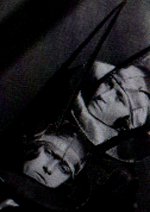
Jaromír Funke,
After the Carnival,
1924
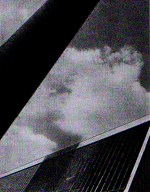
Eugen Wiškovský,
Kolín Power Station,
1932
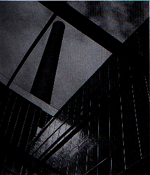
Jaromír Funke,
Kolín Power Station,
1932